
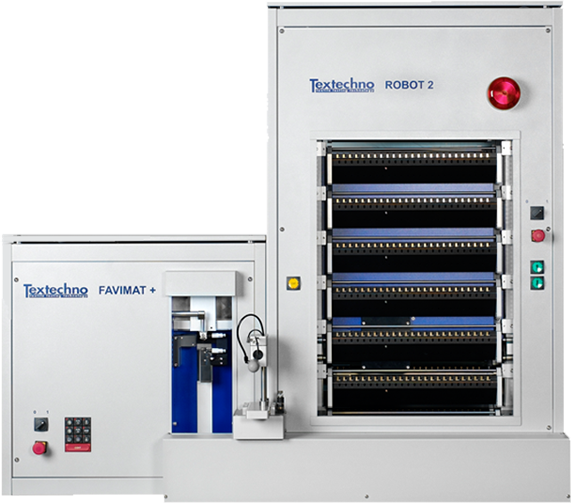
The importance of carbon fibers as a reinforcement material in energy-saving lightweight composites is well accepted. Fast and reliable, i.e. automated, linear-density- and tensile testing of carbon fibers thus becomes increasingly important. Due to the special properties of carbon fibers an automatic handling of individual filaments has been considered to be problematic. TEXTECHNO in Mönchengladbach realizes an automated test of linear-density- and tensile properties on such carbon filaments in their automatic fiber test system FAVIMAT+ with ROBOT 2.
Automatic Testing
For such automatic testing of carbon fibers the filaments are first inserted into a magazine. The magazine storage of the ROBOT 2 system can take up to 20 magazines with 25 fibers each – so up to 500 fibres can be tested fully automatically. The linear-density-, tensile-, as well as elastic properties are then tested without manual interference.
Direct Clamping
The vibroscopic linear-density test as well as the tensile- and elasticity test are performed in the FAVIMAT+ single-fiber tester. These tests are done on exactly the same fiber section and clamping the fiber only once. In comparison to the testing of laminated rovings, this method has a big advantage: First results are already available after a few minutes and not only after several hours.
Moreover, in FAVIMAT+ the fibres are clamped directly in the yaws with a yaw face combination that has been optimized by Textechno for decades. With this direct clamping, there is no need for an insertion into tabs, paper frames, adhesives or gluing as for instance know from ISO 11566. Compared to other handling methods, this results in a huge time benefit: Operators can walk up to FAVIMAT+ with a strand of carbon fibres and return with a full test result of 20 tested individual fibres within 15 minutes.
Vibroscopic Measurement of Cross-Sectional Area
The FAVIMAT+ is employed successfully by producers and users of carbon fibres as well as in research institutes. It is a universal tester, suitable for all types of fibres. Its excellent length- and force resolution (1 µm and 0.1 µN) makes it an interesting testing instrument also for other applications as for instance tensile tests on nano nonwovens or carbo nanotubes.

During the vibroscopic linear-density test, the instrument automatically determines the resonance frequency of the basic transversal oscillation under well-defined tension and oscillating length. Taking the density of the tested material into account (for instance 1.8 g/cm³, typical for carbon fibres), the effective cross-sectional area can easily be determined. Here, the precision is in general better than a determination by optical means, since the vibroscopic method is independent from the shape of the cross section or optical properties of the fibres. Kidney shaped, hollow or transparent fibres are no problem. Moreover, in FAVIMAT+ the cross-sectional area is measured over the exact same section of the fibre where subsequently the tensile test is performed without additional moving, handling or transport of the fibre. The measuring principle can be extended to a complete vibrational analysis for the determination of further parameters such as the bending stiffness.
Data and Accuracy
The combined measurement of cross-sectional area and tensile strength on the same single carbon fiber filament allows to translate the force-elongation curve directly into a stress-elongation curve. This is done by normalizing the forces measured in cN by the individual cross-sectional areas of each carbon fiber to receive the stresses in GPa during the tensile test. As can be seen in the exemplary data below, individual carbon fibres align perfectly on top of one-another in their stress-elongation curves (middle) when measured with FAVIMAT+. Likewise, also the derivatives of these stress-elongation curves are directly available in the units of GPa yielding an immediate measurement of the modulus of the fiber. Testing fibre materials of the highest homogeneity, coefficients of variation of the modulus below 0.1 % were found, pointing at the extreme accuracy of FAVIMAT+.

Compliance Testing
Various single-fibre testing standards such as ASTM C1557, ASTM D3822 or ISO 11566 call out for a determination of system compliance to compensate for a potential deformation of the tensile tester under load during the tensile test. FAVIMAT+ has an automatic method to easily determine the system compliance factor k as defined in ISO 11566 by performing measurements at various gauge length. The resulting compliance factor can be applied automatically to tensile tests. Since FAVIMAT+ is equipment with a zero-displacement force measurement system, compliance factors are typically below 0.1 mm/N (k<0.1 mm/N) and hence only make a small difference to the tensile test results.
Fibre/Matrix-Adhesion Testing and Further Testing Methods
Finally, FAVIMAT+ is used within Textechno’s FIMATEST system to precisely measure the fibre/matrix-adhesion by means of single-fibre pull-out tests. The system won the JEC innovation award and its testing method has recently been standardized as DIN SPEC 19289.
Further testing methods implemented in FAVIMAT+ include fibre-to-metal friction, geometrical and mechanical crimp properties, fibre bending stiffness, wet-testing and more.
References
Searching for FAVIMAT+ on Google Scholar hundreds of references are found where FAVIMAT+ was invoked in scientific research including on carbon fibres.
Back to Overview